
The RACER Mailbag, October 7
Welcome to the RACER Mailbag. Questions for any of RACER’s writers can be sent to mailbag@racer.com. We love hearing your comments and opinions, but letters that include a question are more likely to be published. Questions received after 12pm ET each Monday will be saved for the following week.
Q: I love IMSA, have been going to races since 1978, and I’m convinced the driving standards in the IMSA WeatherTech Championship are getting out of hand and result in too much carnage and an excessive number of full course yellows – nine FCYs each at Watkins Glen and Road America, and 16 at Road Atlanta.
I read and hear that Beaux Barfield has warned drivers to give each other room but the roughhousing seems to be increasing. Is this seen as a serious problem by IMSA, the teams and drivers, and do the parties want to correct it? If so, what have you heard about this from within the paddock?
I recall a piece Marshall Pruett wrote on RACER.com about the poor driving at the 2015 Sebring 12 hours that resulted in five hours under FCY. Maybe nothing has changed.
David, Danville, CA
MARSHALL PRUETT: With the devolving state of driving standards, I’ve been having flashbacks to my early childhood when my mom would threaten to spank me when I was misbehaving and how I ignored her threats because she was too kind-hearted to carry out the corrective behavior I needed. So I’d keep going. I had no fear of her, and when I did get punished, it was being sent to my room…where all of my toys and fun stuff could be found.
My dad? At 6’2” and with a belt at the ready, I straightened up immediately and behaved like the perfect son. All because I feared the repercussions he would bring to bear if I acted out.
It’s unfair to place the same expectations on Beaux Barfield to strike the same kind of fear in a field of 150-ish drivers at Petit, or any other race, but it did come to mind during the race of how somewhere among the 16 eventual cautions, that most competitors must think of him like I did with my mom.
There are deeper reasons for the roughhousing you mentioned, but if drivers aren’t worried about the repercussions of their actions, nothing will change.
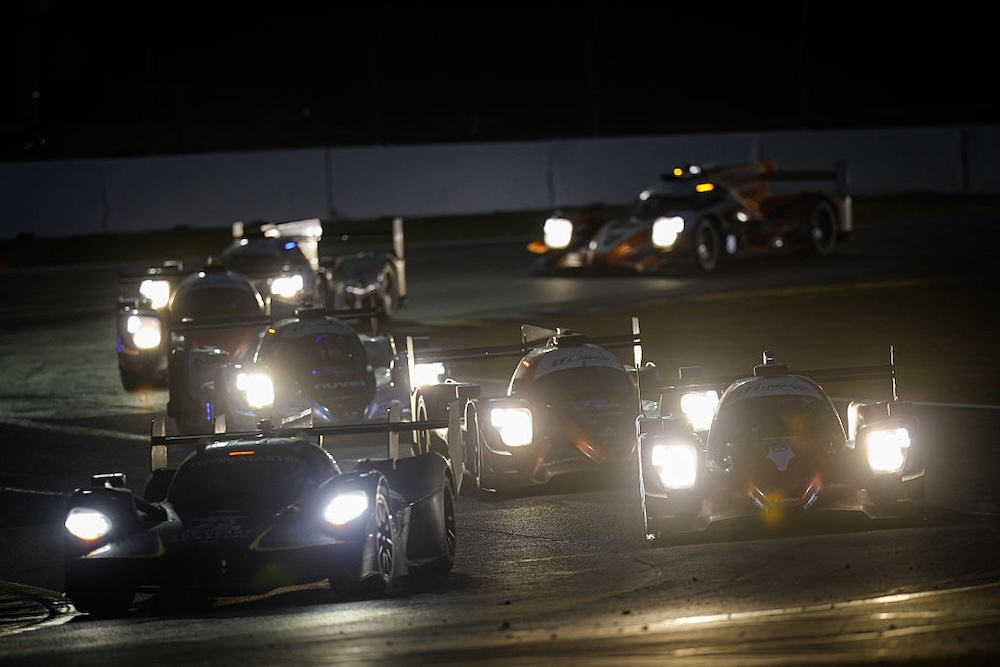
It can get a little messy in there. Jake Galstad/Lumen via Getty Images
Here’s an idea I love: The “Shared Pain” penalty concept. Let’s give that a try. Driver 1 misses their braking point and blasts into the back of Driver 2, who gets knocked off the road and stuck into a gravel trap.
Driver 1 would normally get a drive-through penalty for avoidable contact, and if it’s really bad, it could be a Stop-and-30 or Stop-and-60. Cool. Keep that. But we’re not done. How much time did Driver 2 lose while trapped in the gravel? If they can’t continue due to damage, Driver 1 and their car is out as well. Shared Pain Rule.
If Driver 2 can continue and needs to pit for inspection and repairs, Driver 1 gets to pay a second penalty by sitting in the penalty box for the amount of time Driver 2 lost in the gravel and pit lane.
But we’re not done! There’s a third tier to the Shared Pain Rule. How long did the caution last that inconvenienced fans? Say, 15 minutes? Well, welcome back to pit lane Driver 1, because your hapless hit on Driver 2 has more idle time to endure.
I’m still not convinced on the third part; maybe that’s an instant fan poll by IMSA where it gets applied or ignored based on a yes or no vote? Either way, I’m a big believer in the Shared Pain concept because it turns brainfarts into self-penalty situations.
I’m not talking about hard racing where quality drivers are beating on each other a little bit and one loses a position to the other. I’m talking about the stupid stuff we see that has us asking what on earth the person was doing or thinking that led to the contact and caution. If your actions seriously harm the race of another, you don’t get a drive-through and get to keep racing in a normal manner.
The rest of your race is tied to the driver or drivers you harmed, and if their days are ruined, well, you just ruined your own, and the days for your teammates, crew members, and sponsors. I wonder if the Shared Pain Rule might make a difference.
Q: Midway through watching Petit Le Mans, looking at a caution pit sequence and how tight the GTP stalls are. Wouldn’t it make sense to pit GT and GTD on the opposite side of the pit area given they are separate races anyway?
Dmangrey, Nolensville, TN
MP: All of the haulers, and Michelin, are on the inside paddock area. More than half of the teams would need to move over to the outside paddock and pit lane Friday night or Saturday morning, after the Michelin Pilot Challenge paddock packs up and leaves after their late-Friday season finale. And then you have the issue of support by Michelin. Sounds like a giant pain to me.
Marshall Pruett
The 2026 season marks Marshall Pruett's 40th year working in the sport. In his role today for RACER, Pruett covers open-wheel and sports car racing as a writer, reporter, photographer, and filmmaker. In his previous career, he served as a mechanic, engineer, and team manager in a variety of series, including IndyCar, IMSA, and World Challenge.
Read Marshall Pruett's articles
Latest News
Comments
Comments are disabled until you accept Social Networking Cookies. Update cookie preferences
If the dialog doesn't appear, ad-blockers are often the cause; try disabling yours or see our Social Features Support.